


 Blog
Blog
Key Features to Look for in a High-Capacity Aerial Logistics Drone: A Comprehensive Technical Checklist
Demand for high-capacity aerial logistics drones has grown sharply with advances in technology and the need for fast, efficient delivery. A technical checklist.
Editor’s note, August 2026. This post is from March 2026 and describes what Grasshopper was building at the time. The full-scale e350 was never built. Its scale proof of concept flew in September 2025, and we closed the chapter in 2026. See the e350.
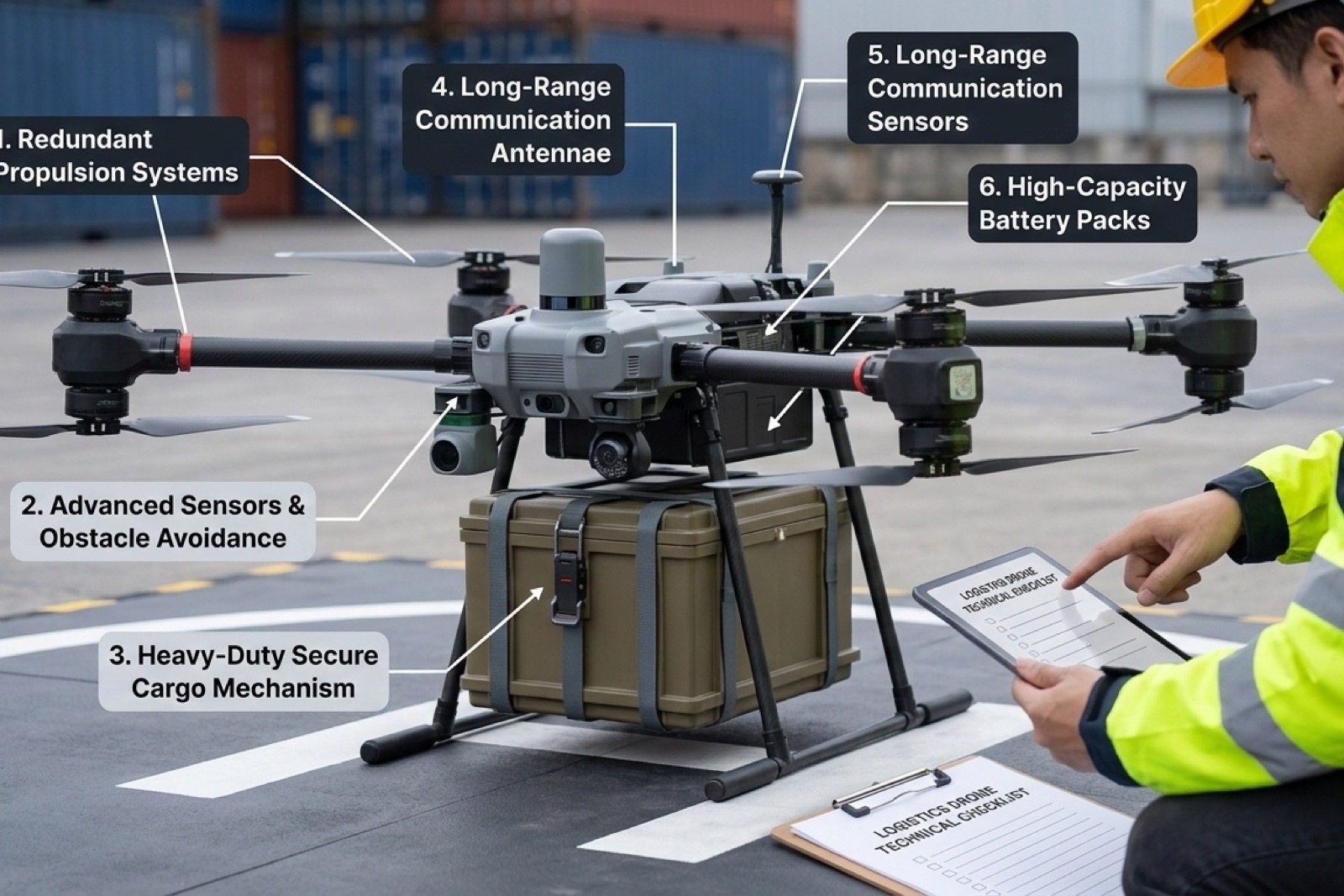
In recent years, the demand for high-capacity aerial logistics drones has grown significantly due to advancements in technology, the rise of e-commerce, and the increasing need for fast, efficient delivery solutions. These drones offer a wide range of benefits, including reduced delivery times, access to hard-to-reach areas, and the ability to handle large payloads. For businesses looking to integrate aerial logistics drones into their operations, understanding the key features that define a high-capacity drone is crucial. This article presents a comprehensive checklist of the essential technical features to consider when selecting such drones, with a special mention of the innovative company Grasshopper Air Mobility and its contributions to the field.
1. Payload Capacity
The payload capacity is arguably the most important factor when selecting a high-capacity aerial logistics drone. This refers to the maximum weight a drone can carry while maintaining optimal performance, including speed, stability, and battery life.
-
Payload range: Depending on the mission requirements, some drones can carry small packages, while others are designed for much larger payloads. High-capacity drones often feature payload capacities upwards of 10 kg (22 lbs), with some models designed to handle up to 100 kg (220 lbs) or more.
-
Customization: Some manufacturers offer customizable payload bays to accommodate a variety of cargo types, including irregularly shaped packages or sensitive items.
Grasshopper Air Mobility, a company in this weight category, designs for significant payloads while maintaining reliability and performance.
2. Battery Life and Range
Battery life is a critical component of aerial logistics drones, particularly for high-capacity models. Longer battery life equates to greater operational range, which can reduce the need for frequent recharging or battery swapping.
-
Battery type: The best drones in the high-capacity category use advanced lithium-polymer (LiPo) or lithium-sulfur (Li-S) batteries that offer higher energy densities and longer lifespans.
-
Operational time: Drones with longer battery life are capable of flying for longer periods. For high-capacity drones, the typical range is between 30 minutes to 1 hour per flight, depending on the payload and operational conditions.
-
Charging speed: Fast-charging capabilities are also a feature to look for, enabling drones to be ready for the next mission quickly.
3. Autonomous Flight Capabilities
Autonomous flight technology is essential for high-capacity aerial logistics drones, enabling them to operate safely and efficiently without constant human intervention. Autonomous capabilities include the ability to plan flight paths, avoid obstacles, and make decisions based on real-time data.
-
GPS and navigation systems: High-capacity drones should be equipped with precise GPS and other navigation systems like RTK (Real-Time Kinematic) to ensure accurate positioning and seamless route planning.
-
Obstacle detection and avoidance: Advanced sensors (LiDAR, infrared, and cameras) help drones detect and avoid obstacles during flight, ensuring safety, especially in crowded or complex environments.
-
Failsafe systems: To prevent accidents, high-capacity drones must have built-in failsafe systems that can trigger an emergency landing in case of GPS failure or other malfunctions.
Grasshopper Air Mobility designed autonomous flight systems into its aircraft, intended to deliver cargo with minimal manual oversight while maintaining safety standards.
4. Landing and Takeoff Systems
Landing and takeoff mechanisms are critical to the effectiveness and safety of aerial logistics drones. These systems need to be designed to accommodate various environments, including urban areas, remote locations, and uneven surfaces.
-
Vertical takeoff and landing (VTOL): Many high-capacity drones are VTOL-capable, allowing them to take off and land in confined spaces without the need for runways. This is particularly important for urban logistics, where space is limited.
-
Stability and precision: The landing system must ensure that the drone can land safely on various terrains, whether flat, inclined, or uneven.
-
Foldable arms: Some high-capacity drones feature foldable wings that reduce the size of the drone during transport, enhancing convenience.
5. Durability and Weather Resistance
Aerial logistics drones often operate in challenging weather conditions. Ensuring that the drone is durable and weather-resistant is essential for minimizing downtime and increasing the drone’s operational lifespan.
-
Weatherproofing: Look for drones that are resistant to water, dust, and extreme temperatures. IP-rated enclosures can protect internal components from environmental damage.
-
Temperature tolerance: Drones designed for high-capacity logistics should function well in a wide range of temperatures, from sub-zero conditions to hot climates.
6. Integration with ERP and Logistics Systems
One of the most important features for businesses adopting high-capacity aerial logistics drones is the ability to integrate with existing Enterprise Resource Planning (ERP) and logistics systems. This integration ensures seamless data exchange between the drone fleet and backend software, allowing for efficient management and tracking of shipments.
-
Real-time tracking: Drones should be able to transmit live data, including location, status, and battery life, to an ERP system, which helps businesses track shipments in real-time.
-
Automated scheduling and dispatching: Integration with logistics management platforms enables automatic scheduling and dispatching of drones for optimal delivery routes and times.
-
Data synchronization: Drones need to synchronize with backend databases to ensure accurate inventory management and order fulfillment.
Grasshopper Air Mobility’s drones are designed to be equipped with advanced integration capabilities, allowing businesses to seamlessly incorporate drone deliveries into their existing logistics infrastructure.
7. Advanced Communication Systems
Effective communication systems are essential for ensuring safe and reliable drone operations, especially for high-capacity drones that carry significant payloads.
-
Long-range communication: High-capacity drones should support long-range communication systems, such as cellular networks or satellite-based communication, to maintain contact with the control center even in remote areas.
-
Low-latency communication: Low-latency communication ensures that commands are executed without delay, which is crucial for safe navigation, especially in emergency situations.
-
Data security: Drones should employ encrypted communication channels to safeguard data transmitted between the drone and its operators.
8. Safety and Regulatory Compliance
Safety is paramount when operating high-capacity aerial logistics drones. These drones must comply with the relevant aviation regulations and safety standards to ensure safe operations and prevent accidents.
-
FAA and EASA certification: For drones operating in the U.S. and Europe, adherence to the Federal Aviation Administration (FAA) and European Union Aviation Safety Agency (EASA) regulations is crucial.
-
Redundancy systems: High-capacity drones should have redundant systems in place for critical components like propulsion, navigation, and power to prevent failures.
-
Emergency protocols: Drones should be equipped with emergency protocols, such as automatic return-to-home features and parachute deployment systems, to minimize risks during malfunctions.
9. Scalability and Fleet Management
As businesses expand their drone operations, the ability to scale and manage a fleet of high-capacity drones becomes increasingly important. Fleet management features help operators track, monitor, and maintain multiple drones efficiently.
-
Fleet tracking: Centralized fleet management software allows operators to monitor the status of all drones in real time, ensuring efficient dispatch and maintenance.
-
Maintenance scheduling: High-capacity drones should be equipped with predictive maintenance features that alert operators when parts need replacement or maintenance, reducing downtime.
-
Scalability: The system should be flexible enough to scale with growing operations, allowing for easy addition of drones to the fleet.
Choosing a high-capacity aerial logistics drone comes down to the criteria above: payload, endurance, autonomy, landing, weather, integration, communications, compliance and fleet management. Grasshopper Air Mobility designs against that list rather than around it, and the e350 concept is where most of these questions were first worked through.